What Is Ytterbium Metal Used For?
Ytterbium Metal has uses that are less familiar than those of iron, copper, or aluminum. Its value often comes from its unusual optical and magnetic behavior, and from its role as a starting material for specialized alloys and research compounds. In practice, the pure metal is not a common everyday material. It is reactive, so handling and storage require controlled conditions.
Its most visible technological connection is to ytterbium-based lasers. These devices typically use ytterbium ions in a host material, rather than a piece of pure metal, to produce efficient laser output. Such lasers can support precise cutting, welding, and scientific measurements. Ytterbium isotopes also help researchers develop highly accurate optical clocks. Small differences in their energy transitions can be measured with exceptional precision. That work may improve timekeeping and tests of fundamental physics.
There are quieter applications, too. Ytterbium has been studied in alloys and in materials used to measure mechanical stress, where changes in its behavior can reveal strain. These are specialized settings, not routine consumer uses. The distinction matters: claims about “ytterbium metal applications” sometimes blur the difference between the metal itself and materials containing ytterbium. That can make the subject sound simpler than it is. A useful overview should clarify what the element does, where it is actually used, and why some promising applications remain largely experimental. Its role is real, but often indirect.
Key Properties of Ytterbium That Enable Its Uses
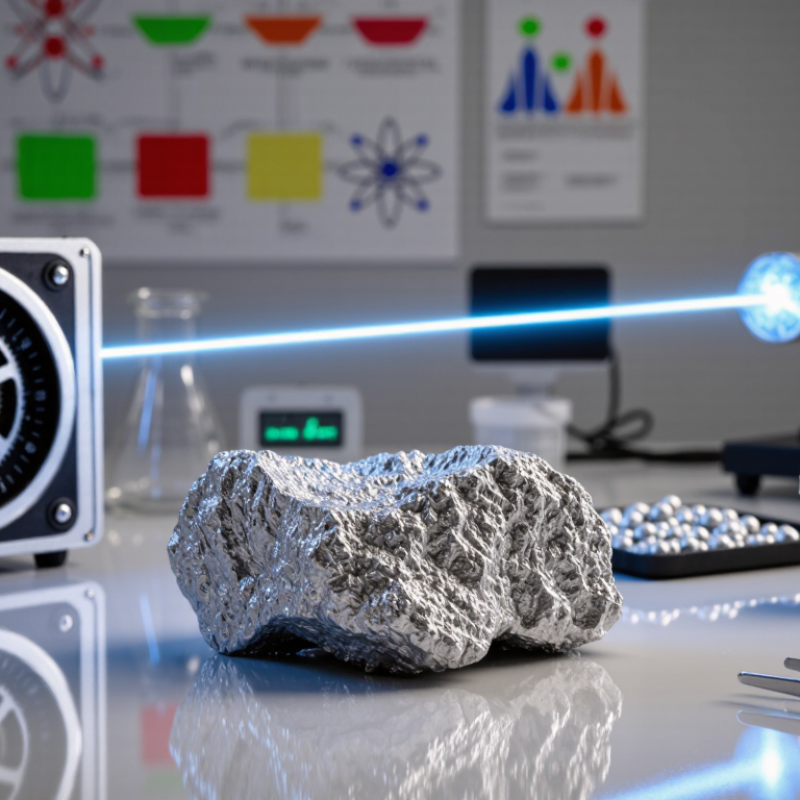
Ytterbium’s uses begin with its unusual combination of properties. It is a soft, silvery rare-earth metal that can be shaped, though it tarnishes when exposed to air. Its atoms have energy levels that produce precise, stable light signals. That makes ytterbium useful in certain solid-state lasers and optical devices, where controlled light matters more than the metal’s appearance. Some ytterbium compounds also help make specialized glass and ceramic materials.
Ytterbium can exist in more than one oxidation state, especially +2 and +3. This chemical flexibility helps researchers tailor its behavior in alloys and materials. Small amounts added to stainless steel can alter grain structure and improve some mechanical properties. The results depend on composition and processing, so ytterbium is not a simple, universal strengthening ingredient. Its isotope ytterbium-173 is also used in atomic-clock research because its energy transitions can be measured with great precision. The metal itself is not the clock; it is part of a carefully controlled system.
Tips: When evaluating an ytterbium application, check whether it uses the metal, a compound, or a specific isotope. Those forms behave differently. Keep samples dry and protected from air; even basic handling details can affect results. It is tempting to call ytterbium a miracle material, but its value is specific—and sometimes overstated.
Ytterbium in Fiber Lasers and Optical Amplifiers
Ytterbium metal is rarely used as a structural material. Its greater value appears in ytterbium-doped fiber lasers and optical amplifiers. These systems use ytterbium ions inside a silica fiber. Pump light excites the ions, then stimulates emission near 1.03–1.08 micrometers. The result is a compact beam with high power and strong electrical efficiency. Industry reports commonly place fiber-laser efficiency above 30%, although real results depend on cooling, pump design, and operating wavelength.
The 2024 MarketsandMarkets fiber-laser report estimates that the global market will grow from about USD 7 billion in 2023 to more than USD 10 billion by 2028. This growth reflects demand from metal cutting, welding, sensing, and medical equipment. Ytterbium amplifiers also support high-power optical links and scientific instruments operating near one micrometer. They are not a universal replacement for erbium systems used in the conventional telecom band. That distinction matters. Some marketing claims simplify it too much.
Tips
Match the dopant to the wavelength. Check gain, noise figure, thermal load, and photodarkening data before selection. The IEC 60825-1 safety framework should guide laser classification and controls. Test performance at the intended duty cycle, not only at peak power. In practice, a slightly lower output can deliver better long-term stability.
Ytterbium in Atomic Clocks and Precision Measurement
What Is Ytterbium Metal Used For?
Ytterbium is used in optical atomic clocks, where its atoms provide an exceptionally stable frequency reference. In practice, researchers heat a small ytterbium source inside an ultra-high-vacuum chamber. Lasers then cool and prepare the atoms. A standing wave traps them in an optical lattice, reducing unwanted movement and collisions. This careful setup helps scientists measure a narrow transition near 578 nanometers.
The clock compares that atomic transition with an extremely stable laser. Any frequency difference reveals the passage of time with remarkable precision. These systems can detect changes smaller than a fraction of a second over the age of the universe. That sounds almost unreal. Yet the measurement depends on temperature control, magnetic shielding, laser stability, and accurate frequency counting. Even tiny vibration can matter.
Ytterbium clocks may improve satellite navigation, telecommunications, geodesy, and tests of fundamental physics. Clocks placed at different elevations could detect gravitational time shifts across small height differences. Researchers also compare ytterbium with other atomic references to search for possible changes in fundamental constants. The metal itself is not simply placed inside a clock. It serves as the carefully controlled source of atoms. I would not describe the technology as flawless. Blackbody radiation, imperfect cooling, and background collisions still demand correction. Progress often comes from measuring these errors more honestly.
Ytterbium in Alloys, Medical Imaging, and Research
What Is Ytterbium Metal Used For?
Ytterbium supports specialized alloys, medical imaging research, and advanced laboratory work. In alloys, small additions can refine grain structure and improve strength. Some engineers also study ytterbium for lowering electrical resistance in precision components. The results depend heavily on purity and processing. It is not a universal alloying solution.
The U.S. Geological Survey’s Mineral Commodity Summaries 2024 reported about 350,000 metric tons of global rare-earth mine production in 2023, measured as rare-earth oxide equivalent. However, the report does not separate ytterbium output. That limitation matters. Supply discussions can sound more precise than the data allows. In medical imaging, ytterbium-169 emits relatively low-energy gamma radiation and has a half-life near 32 days, according to International Atomic Energy Agency data. Researchers have examined it for compact imaging sources and targeted radiation studies. These applications remain specialized, rather than routine hospital practice. Ytterbium-doped lasers also support optical imaging experiments, spectroscopy, and biomedical instrument development.
Tips: Check the isotope, purity, and intended device before comparing materials. Ytterbium metal and ytterbium-169 are not interchangeable. Review safety documentation and independent technical data. A material that performs well in a laboratory may behave differently in a clinical instrument. Researchers should also verify calibration, shielding, and waste procedures against current national requirements. That step is easy to overlook.
Safety and Practical Limits of Ytterbium Applications
What Is Ytterbium Metal Used For?
Safety and Practical Limits of Ytterbium Applications
Ytterbium metal supports specialized photonics, precision measurement, and laboratory research. Its strongest role is often indirect. Ytterbium ions are added to glass fibers, where they help amplify laser signals efficiently. These fiber lasers can support cutting, sensing, communications, and scientific instruments. Solid ytterbium also assists research on atomic clocks and quantum systems. The metal is soft and silvery. It slowly tarnishes in air.
Commercial scale remains limited. The U.S. Geological Survey’s Mineral Commodity Summaries 2025 reported global rare-earth mine production near 390,000 metric tons of rare-earth oxide equivalent in 2024. That figure covers the whole rare-earth group, not ytterbium alone. Ytterbium requires additional separation from neighboring heavy rare earths. This makes supply less flexible and prices more sensitive than general production figures suggest. That distinction is easy to miss.
Safety limits matter more than impressive laboratory results. Clean metal should be stored in tightly closed containers, away from moisture, oxidizers, and ignition sources. Fine filings and powders can burn more readily than bulk pieces. A workplace risk assessment should follow the current safety data sheet, local chemical rules, ventilation requirements, and suitable protective equipment. NIST reference data supports ytterbium’s use in precision research, but it does not remove handling risks. I would not treat a small sample as harmless. Surface oxidation, contamination, and particle size can change its behavior.
What Is Ytterbium Metal Used For? - Safety and Practical Limits of Ytterbium Applications
Natural isotopic abundance helps explain why ytterbium is valuable in lasers, precision measurement, and scientific research.
How to read the chart: Ytterbium occurs naturally as seven stable isotopes. Ytterbium-171 is especially important in optical-clock research, while ytterbium-doped materials are used in efficient fiber lasers and amplifiers.
Practical limits and safety: Ytterbium is a soft, reactive rare-earth metal with a melting point of approximately 824°C and a boiling point near 1,196°C. Fine metal powder can present fire and dust hazards, and compounds require exposure controls based on their specific safety data. Use sealed handling systems, suitable respiratory protection, and controlled storage; there is no single universally adopted occupational exposure limit for all ytterbium substances.